靈格斯上的朗文當代英英辭典的解釋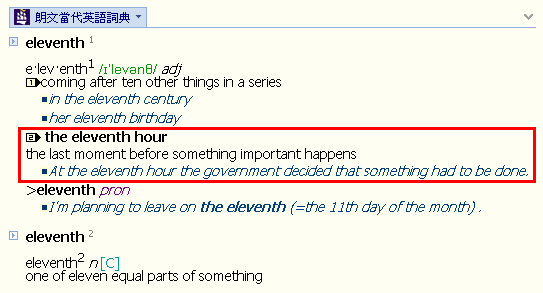
為甚麼是第11小時?
The eleventh hour is the last possible moment at which something can be done, or which problems or solutions might arise. The phrase, “at the eleventh” hour became popular in the 19th century, but was in use much earlier. It alludes specifically to the book of Matthew in the New Testament (20:2-16).
This account in Matthew is a parable regarding workers who arrive at the eleventh hour of the workday and are still paid a full day’s wage. Biblical scholars have suggested that the parable can mean that even people who come to Christianity late in life, at the eleventh hour, will still earn the full benefits of the joys of eternal life.
Some scholars have even dated the eleventh hour as specifically the hour between 5 and 6 pm, since the typical workday would have been from sunup to sunset, or between 6am, and 6 pm. This very literal meaning seldom applies to eleventh hour as it is used commonly. Instead, it simply means “at the last possible time.”
Some relate “at the eleventh hour” to procrastination, and view the phrase in a negative sense. For example Constantine’s deathbed conversion to Christianity seems unfair to some Christians, and is an eleventh hour conversion. A student who waits until the eleventh hour to write a paper or finish an assignment has certainly procrastinated, and may turn in work that is not carefully thought out or well-prepared.
In other circumstances, an eleventh hour solution is viewed positively. For example in the sentence, “At the eleventh hour, the Teachers’ Union and the School Board were able to negotiate a contract,” the phrase is used positively. If the contract hadn’t been negotiated, then the Teachers’ Union might have had to go on strike. In other words, sometimes a last minute solution saves the day.
At other times, a problem may present at the eleventh hour, which delays something being accomplished. A family who has been packing all day for a trip might have their trip delayed at the eleventh hour by the baby suddenly running a fever. Eleventh hour problems are generally unwelcome occurrences.
轉貼自
What is the Eleventh Hour?
參考資料
What is the Eleventh Hour?
趣味口语:为什么"十一点钟"(at The Eleventh Hour)成了"关键时刻"?
2008/9/17
at the 11th hour
2008/7/6
alive & by the turn of
Q
1.The building collapsed and many people were buried alive.
[Why do we use an adjective"alive" after "were buried"? I thought it should be an adverb....]
2.By the turn of the 20th century, the bodybuilding craze started to pick up steam.
[What does it mean "by the turn of ~"? How can I explain it?]
Thank you very much.
A
1. This is an obscure point of grammar that is
difficult to explain. There might be several ways
to try to explain this. First, there is no adverb version of
the adjective "alive." For example, the adj. "smooth"
has an adverb version "smoothly," and the adj. "weak"
has an adv. version "weakly," but many adjectives do
not have this type of adv. version. One of these is
the adj. "alive": there is no adv. "alively."
However, even if there were such an adv. as "alively,"
in sentences with the structure: Subject--intransitive
verb or transitive verb in passive voice---_______,
such as this one, if the "_____" is an adj., it modifies
the subject, and if the "_____" is an adv., it modifies
the verb. For example, the adj. "rich" has an adv.
version "richly." In the sentence "They were buried
rich.", "rich" modifies "They," that is, they were rich
people who were buried. In the sentence "They
were buried richly.", "richly" modifies the verb: they
are buried in an expensive funeral.
In the sentence "They were buried alive.", "alive" modifies
"They": the people were alive when they were buried.
We're not talking here about them being buried in a
lively manner: even if there were such an adv.
as "alively," it could not be used here.
Still another way of explaining this is that the phrase
"buried alive" is a standard expression that is used
all the time. There are no other words that can be
used as substitutes in this phrase.
Yet another way of explaining it is that this sentence
is elliptical. Over hundreds of years it has been shortened
from the longer, "The building collapsed and many
people where buried while they were still alive.",
for the sake of brevity.
2. The phrase "the turn of the ____ century" means the
beginning of the ___ century. So "the turn of the 20th
century" means the start of the 20th cent., that is,
the year 1900. This phrase is probably metaphorical,
having its origin in the turning of a page in a book.
When you turn the page of a book, the "old" page that
you just read disappears and a new page appears.
Similarly, at the "turn" of the century, the previous
century disappears, so to speak, and the new century
appears.
轉貼自
http://mb.sparknotes.com/mb.epl?b=2437&m=1311145&f=1&t=369919#1311145
2007/11/13
clothse的用法
Q:
posted by mkaya on 11/7 9:41 PM
Can I say "I bought several clothes last week."?
A:
posted by clif on 11/8 11:19 AM
This would not be correct usage. The reason is that the word "clothes" has the connotation of a collection of things, rather than countable things. Thus, you would not use the adjective "several" with it, since several is used with countable things, like: several dresses, several hats, several jackets, etc. --in each of these examples you can easily count the number of dresses or hats or jackets that you have. But the word "clothes" would mean all of your dresses and hats and jackets, etc. ("My clothes are in the bedroom."); or everything that you're wearing ("Those are nice clothes you're wearing."); etc.; and thus it has a singular plural, uncountable quality to it. The way to say this would be: "I bought some clothes last week." The adj. "some" has an indefinite, uncountable quality to it, so it matches the word "clothes," which has that similar uncountable quality.
※ ※ ※
Q:
posted by rotcod on 11/12 12:51 AM
Could I use the adjective "a little" with the word "clothes"? Could I say "I bought a little clothes last week." Thank you.
A:
posted by clif on 11/12 8:17 AM
The phrase "a little" would seem to have the same uncountable qualtiy that "clothes" has. For example, you can say: "There's a little water in the container." or "There's some water in the container." However, you can't say: "I bought a little clothes last week." There is seeming no logical reason why you can't say this, but that's just the way it is in the language. This is just one more example of usage that has to be learned through experience with the language.
轉貼自:http://mb.sparknotes.com/mb.epl?b=2437&m=1290084&f=1&t=363872#1290084
2007/11/8
"aboard" means " on board"
Q:
posted by MAS1981 on 11/5 9:52 AM
Welcome ____ the flight to Taipei. (Why can't I use on or board?) Thank you very much. (Ans: aboard)
A:
posted by clif on 11/5 11:22 AM
The traditional way of welcoming people onto a flight is: "Welcome aboard the flight to Taipei." You can also say "Welcome on board the flight to Taipei." "Aboard" and "on board" mean the same thing. There is technically nothing wrong with "Welcome on the flight to Taipei.", but that's just not the traditional way of greeting passengers. "Welcome, board (that is: get on) the flight to Taipei." is grammatically correct, but it is a very abrupt and rude way to greet passengers.
※ ※ ※
Q:
posted by MAS1981 on 11/6 5:00 AM
How come "Welcome board the fight to Taipei." is abrupt and rude to greet passengers???
A:
posted by clif on 11/6 11:16 AM
In the sentence "Welcome board the flight to Taipei." it depends on how you interpret the words in the sentence. If you interpret the word "board" as a verb, then you're using the verb as a command: "Board the flight to Taipei!" Only on a military flight where the passengers are enlisted men and the greeter is an officer would the passengers be welcomed this way. On a commercial airline flight the passengers would never be commanded to get on the plane like this.
The sentence might be permissible if you interpret
the word "board" as an abreviated form of
"aboard" or "on board"--you're omitting the "a" or
the "on," as in: "Welcome 'board the flight to
Taipei." If you're an experienced flight attendent
and you've said this a million times, you might after
a while get lazy about it an slur your words, omitting
the "a" or "on," and if you do it smoothly with
the right inflection in your voice, this might be
okay in some circumstances. But it would be
better to say the words properly all the time:
"aboard" or "on board."
轉貼自http://mb.sparknotes.com/mb.epl?b=2437&m=1289827&f=1&t=363788#1289827
2007/10/28
shade vs. shadow
shade vs. shadow?
posted by MAS1981 on 8/12 5:06 AM
Alice laid down in the ____ of the tree and fell asleep quickly. (A)branch (B)shadow (C)leaf (D)shade The answer is D. What can't I choose shadow? What's the difference between "shade" and "shadow"? How to discriminate between shade from shadow? Thank you very much.
...
posted by clif on 8/12 11:23 AM
D. is the corect answer. If you put "shadow" in the blank, you would have a sentence that is technically correct from a purely grammatical point of view, but such a sentence would not be appropriate. Again, this comes down to usage versus grammar. Tradition dictates that "shade" be used in this context rather than "shadow." As to the difference between the words. They mean basically the same thing, but "shadow" has very negative connotations, while "shade" has generally pleasant or neutral connotations. "Shadow" has dark and scary implications. The sentence "Alice laid down in the shadow of the tree and fell asleep quickly." might be used in a horror story, where the author is trying to create an ominous and sinister mood. "Shadows" have a creepy connotation--you seek the shade of a tree, which implies something pleasant, relief from the heat; you don't seek the shadow of a tree, that would be ominous
轉貼自http://mb.sparknotes.com/mb.epl?b=2437&m=1281268&f=1&p=2&t=361116#1281268
2007/10/27
rumor has it that
I don't understand this grammar
posted by MAS1981 on 10/5 10:02 PM
"More recently, Puss-in-Boots appeared in the movie Shrek 3, and rumor has it that he may soon star in his own film."--From Studio Classroom "rumor has it that..." Why not using "rumor says that..."? In what situation I would use this sentence pattern? Thank you.
...
posted by clif on 10/6 12:26 PM
The phrase "rumor has it that" is one of the many colloquial expressions in the English language. Like most colloquial expressions, it makes little or no grammatical sense--that's just the way the expression evolved over hundreds of years of tradition and usage. The phrase "rumor says that"--a seemingly viable expression--is not used in the English language. Tthere is no logical explanation for why it is not used; that's just how it is in the language. The expression means something like: "some people are claiming that," or "incomplete information that we have obtained indicates that," or "unsubstantiated reports indicate that," etc. The emphasis here is on the unsubstantiated nature of the claim, so much so, that one should not take the claim too seriously. The phrase is used in situations where you want to put forth some possibility, but with the emphasis that it is unsubstantiated, and that the hearer should not take it as an established fact. For example: Last night X was seen out on the town with Y. Rumor has it that they are an item (a couple). Yesterday X was seen coming out of the offices of Y. Rumor has it that he is in line for the presidency of the company. Today X was seen coming out of the principal's office, looking distraught. Rumor has it that he is going to be expelled from school. And so forth.
轉貼自http://mb.sparknotes.com/mb.epl?b=2437&m=1286362&f=1&t=362714#1286362

 訂閱最新文章


